
5 & 5 With Kim Eichler-Messmer
Jaede Bayala sat down with one of Studios Inc’s new AIR Kim Eichler-Messmer to discuss her practice and plans for her work.
Kim Eichler-Messmer is an Associate Professor of Fiber at the Kansas City Art Institute, where she has taught surface design, quilting, and natural dye since 2008. She grew up in Iowa as an only child to two creative, nature-loving parents. She received a BFA in studio art from Iowa State University where she studied engineering, Spanish, Portuguese, drawing, and printmaking before finally realizing her love of textiles in a yardage screen printing class. She went on to receive an MFA in Textiles from the University of Kansas. She teaches workshops on dyeing and quilting regularly around the United States and her hand-dyed, one-of-a-kind quilts have been exhibited nationally and internationally in numerous solo and juried shows. Kim is the author of “Modern Color: An Illustrated Guide to Dyeing Fabric for Modern Quilts” and her work has been included in “Quilting with a Modern Slant” by Rachel May, and “The Uppercase Compendium of Craft and Creativity” by Janine Vangool, among others.
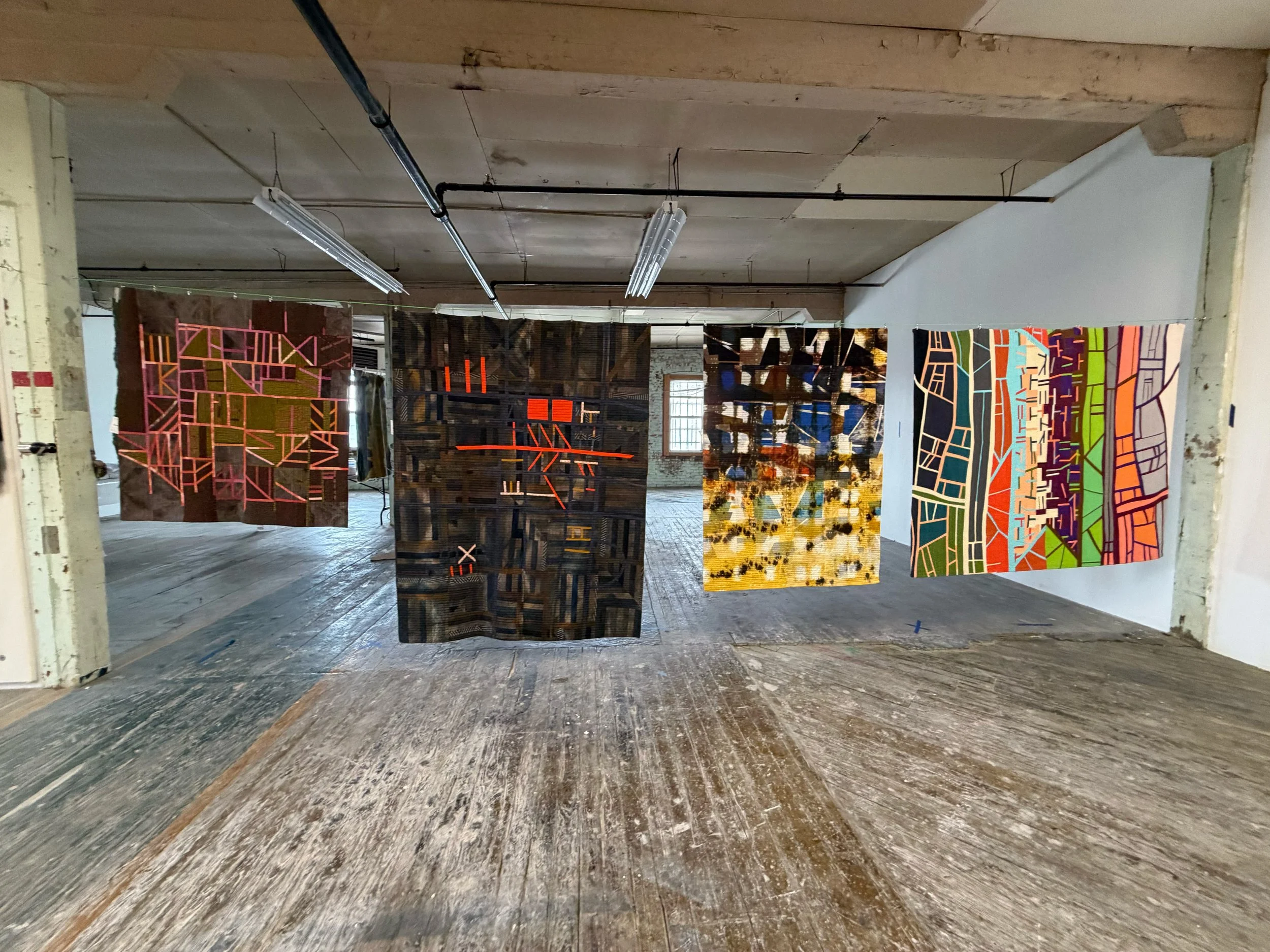
In her artist statement, Messmer shares “In my work I explore the tension between order and disruption, the rigid and the organic, the grid and the gesture. As quilts, these works hold the softness and familiarity of textiles while asserting their presence as considered visual objects. Quilts carry associations of comfort, protection, and intimacy, yet here they also serve as arenas where structure is questioned and reshaped.”
Q: How has travel influenced your work?
A: I feel like it has impacted my work a lot, but not in very concrete, immediate ways. I’ve liked traveling my whole life; experiencing different places and cultures has always been really inspiring, but I don't know that I can point to any direct influence coming through. In 2018, I went to Japan. There was the international shibori symposium, and the focus was on natural dyes and growing them. I was expecting to be really inspired by the natural dyes, but on that trip, I was able to take sashiko workshops, and that ended up having the biggest impact on me. The sashiko slowly started making its way into my work. It's hard to take something from another culture and figure out how to not appropriate it but filter it into who I am and my work. So I started by doing samples and just practicing. That's one example of how it's influenced me. I’ve taken a few trips over the past couple of years. I went to Scotland and Iceland, and a few quilts I’ve made are inspired by the photos I took of the landscapes there, but it's not a clear representation of the place. I was just in Oaxaca, Mexico, in February. I was there to learn embroidery techniques from local artisans who have different traditions specific to their villages. It's kind of the same thing; I don't know how it's going to filter into my work yet. A lot of what I learned there I kind of already knew, but it was more about the use of color and symbolism and how identity is built into the embroidery, and how the women who live there can tell what village another person is from based on the embroidery techniques used on the clothing. That was really interesting to me to think about how something we do for decoration can also represent our identity or where we’re from. A lot of my work is about where I'm from and my identity.
Q: How do you see the languages of dye and stitching communicating with each other?
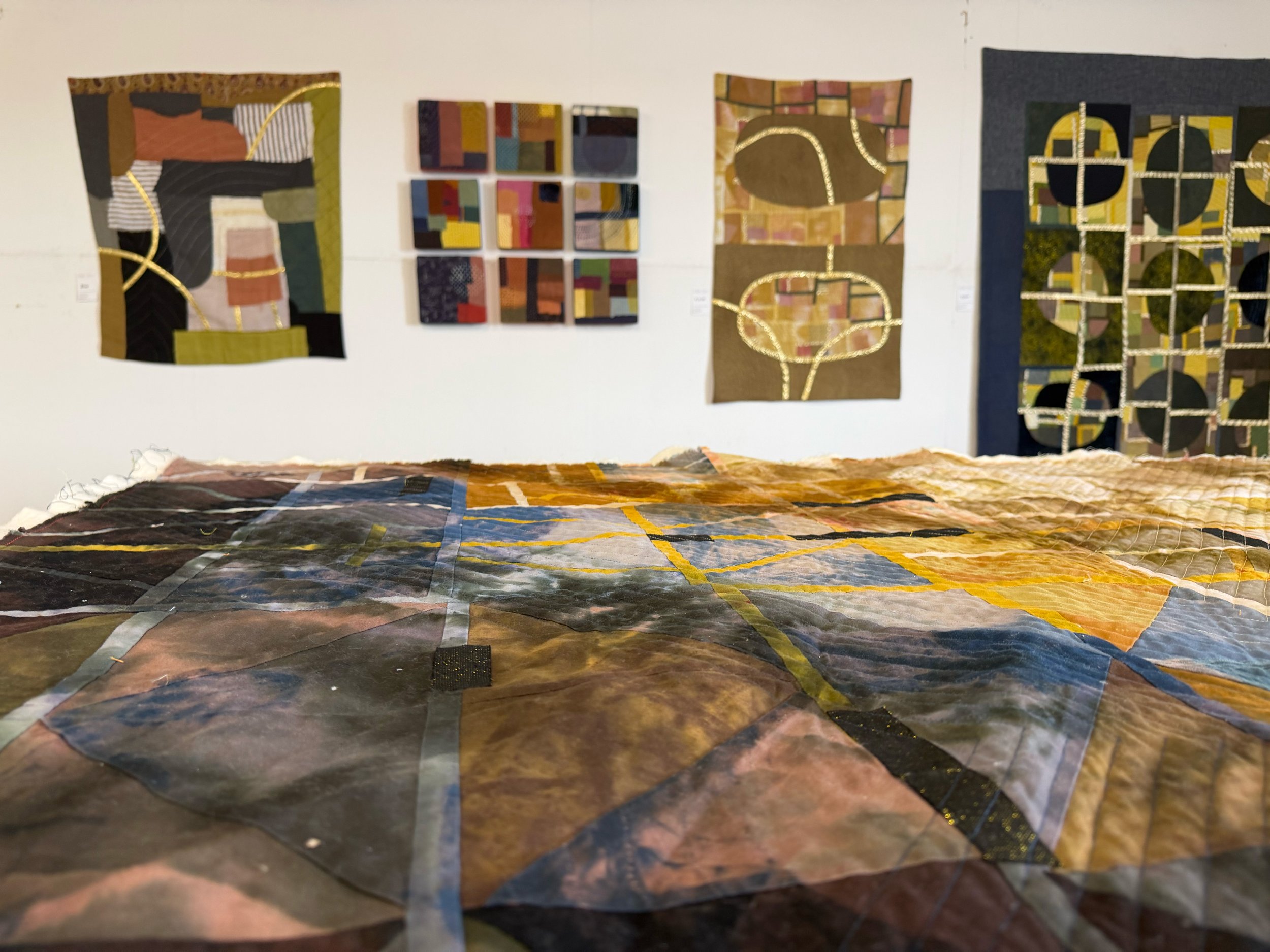
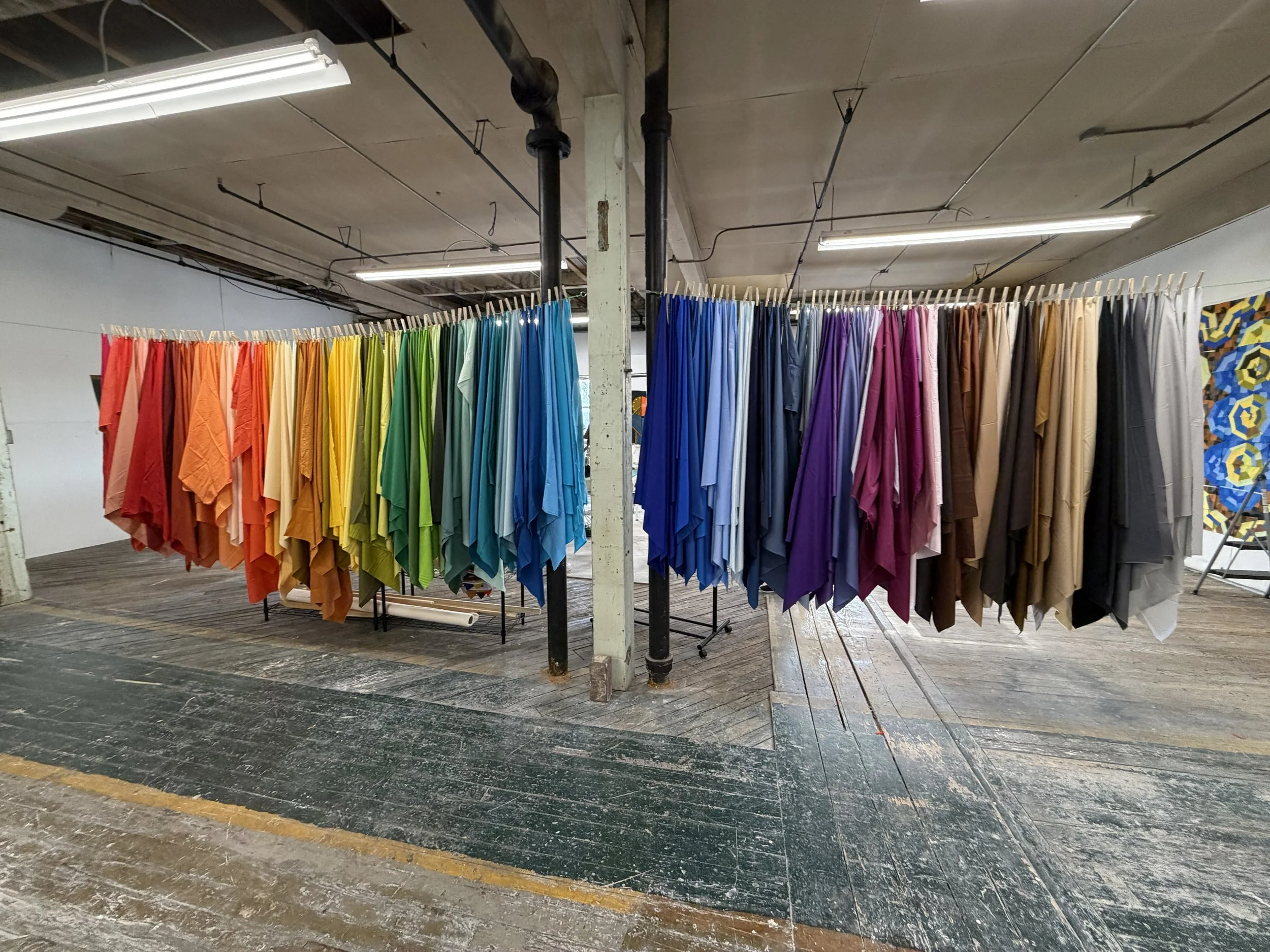
A: I'm super process-driven, and I don't always know what the work is going to look like when I start it. So the dyeing is the way that I get started, it's sort of a warm-up for me. I used to dye all of my fabric and start with white fabric. Now I feel like time is so limited that the act of dyeing feels too slow for me, so I'm starting to use more commercial colors from a quilt shop, and then once a quilt is sewn together, I’ll overdye it and discharge it. So I still have my hands in the dye pot, and that's still a big part of my work, but not in the way it used to be. There are two different ways I think about stitching, and one is machine quilting. Most of my patchwork quilts are machine quilted, and I think of that stitching as part of the construction of the quilt. The more quilting you have, the stronger it makes it, so I do pretty dense quilting, but I also like how it creates another layer of color on top of the piecing, and depending on what thread color you apply, it can create a fog or filter on top of the patchwork. The stitching on those tends to be pretty simple; I don't want to detract too much from what the piecing is. I think of it as grid lines on a map or waves of information or rain or sunlight, things that overlay other things. The hand stitching is much slower and is super different in my mind; it's more meditative, and I think of it more as drawing. I am really thinking about both how to highlight the design of the quilt and how to also add more information and give both myself and the viewer moments of surprise, and those pieces tend to be more about inventive universes.
Q: How do you collect your materials?
A: There are a couple of different ways I do that. I think of my work as two different bodies of work, one is quilts, and the other is quilted collages. So, for those, they are a combination of vintage textiles that I pick up at antique malls or thrift stores. Sometimes when my clothes wear out, and I can’t repair them anymore, I’ll rip out the backs and sleeves. Some are from friends and family members. It tends to be the hand-stitched pieces where I’m collecting more vintage textiles. I'm also collecting on my trips. The rest of the fabric I buy. There's a company I design fabric for called Paintbrush Studios, so I buy colors from them.
Q: With the slowness of hand stitching, do you prefer to work in silence or listen to something?
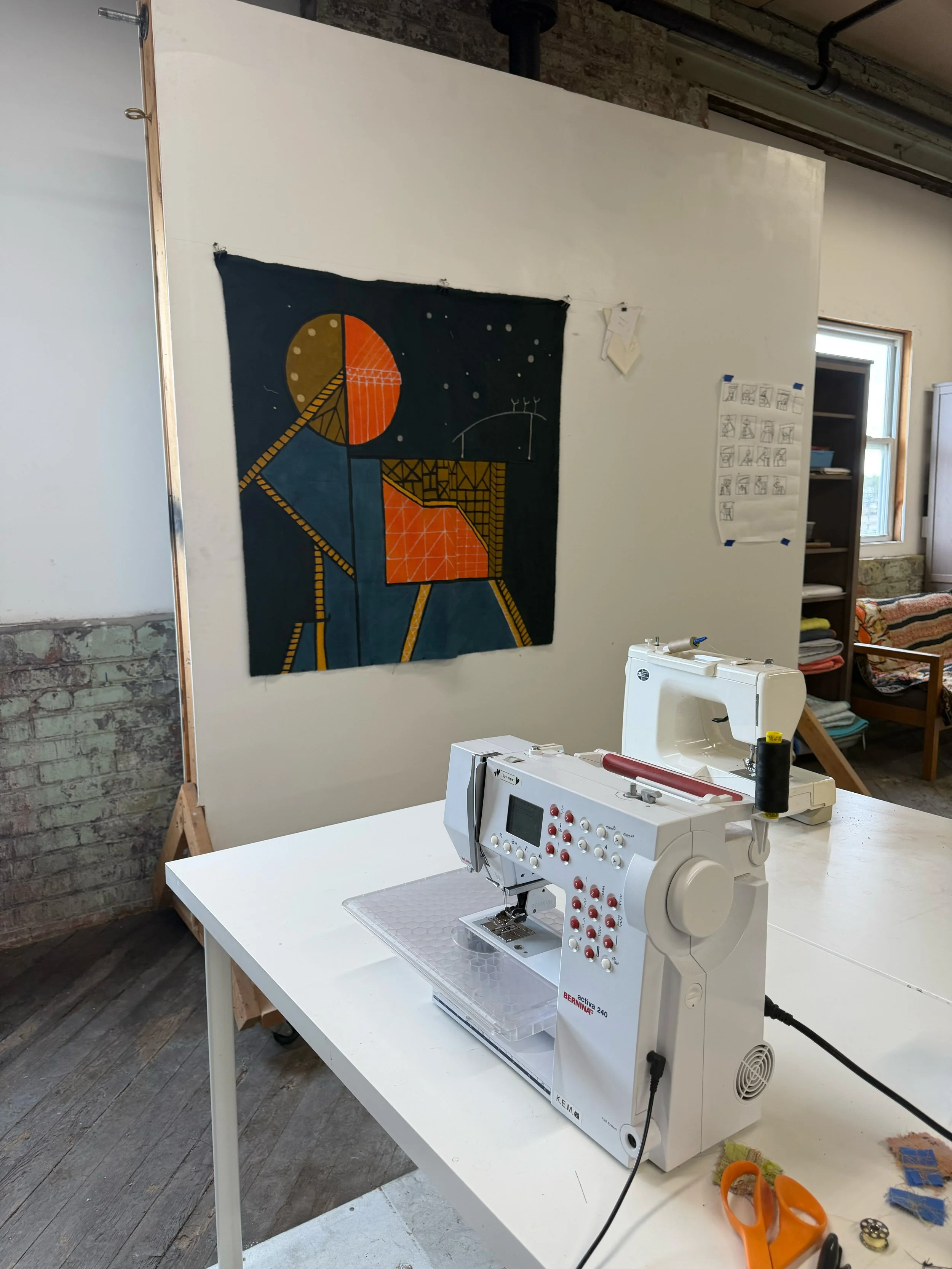
A: I watch a lot of reality TV. I’m working through Love is Blind right now. I’ve watched a lot of Love Island. I find that it's nice to have it on in the background. However, it takes away a little bit from the meditative quality. Depending on what I’m doing, I need different things. When I’m doing patchwork, I need silence because it takes a lot of brainpower. With machine quilting, I’m usually listening to music, and then reality TV for hand stitching.
Q: What are you most excited to do now that you're in this new space?
A: I applied for this studio, wanting to work bigger; that's still something I'm excited to do. Most of my quilts have been in the standard four to six-foot range, and traditional bed quilts are much larger, so I'd like to work up to doing that. I'm excited to have the back space with a dye area set up, and to paint larger pieces of fabric. I have an intern, and I have a show in Ohio in July. We taped out the back part of the gallery with the dimensions of the gallery in Ohio, so I'm kind of excited to be able to start laying out exhibitions much more intentionally. Being able to see things in the space next to each other, I feel like I'm going to be able to make different decisions.
You can learn more about Kim’s work at https://www.kimemquilts.com