
5 & 5 With Melanie Johnson
Assistant Gallery Manager and Staff Writer Jaede Bayala sat down with AIR Melanie Johnson for a studio visit.
Q: You will be a resident at the Friends of Pando Residency. How will going from Utah back to Kansas City influence your work?
A: I’m going on the 5th of August, and the way that it's structured is that it's a year-long residency. They financially cover travel expenses, and so I need to be out there for four or five days living in the Pando, and it's exciting. I haven’t spent that much time with that kind of landscape. I'll go out there and collect information. I plan to do some studies and recording and really just kinda be open to what I'm experiencing, and I'll bring that back to the studio. The structure is to create over the course of the year, and I can go back whenever I need to. It's right before the semester starts, so I have a little bit of a break here to take in information.
Q: Tell me about your show Fieldwork at the Northcutt Steele Gallery.
A: It's been up since May, and I’ll go out in September for a closing reception and do a lecture, so that's large-scale drawings from the last 8 years up until what I’ve been working on recently, so I've been focused on that, and now I can start fresh on a new body of work now that it's out of the studio.
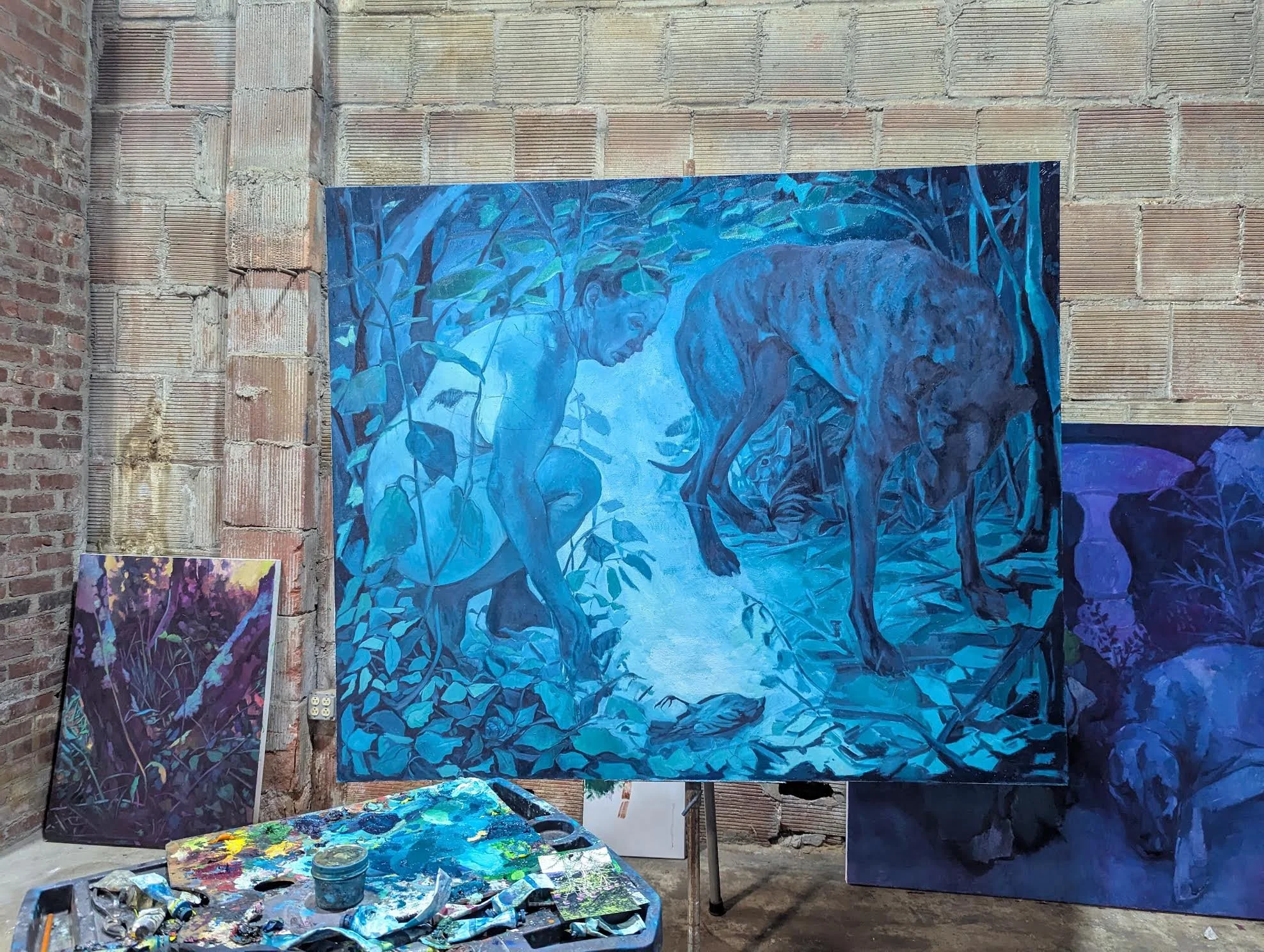
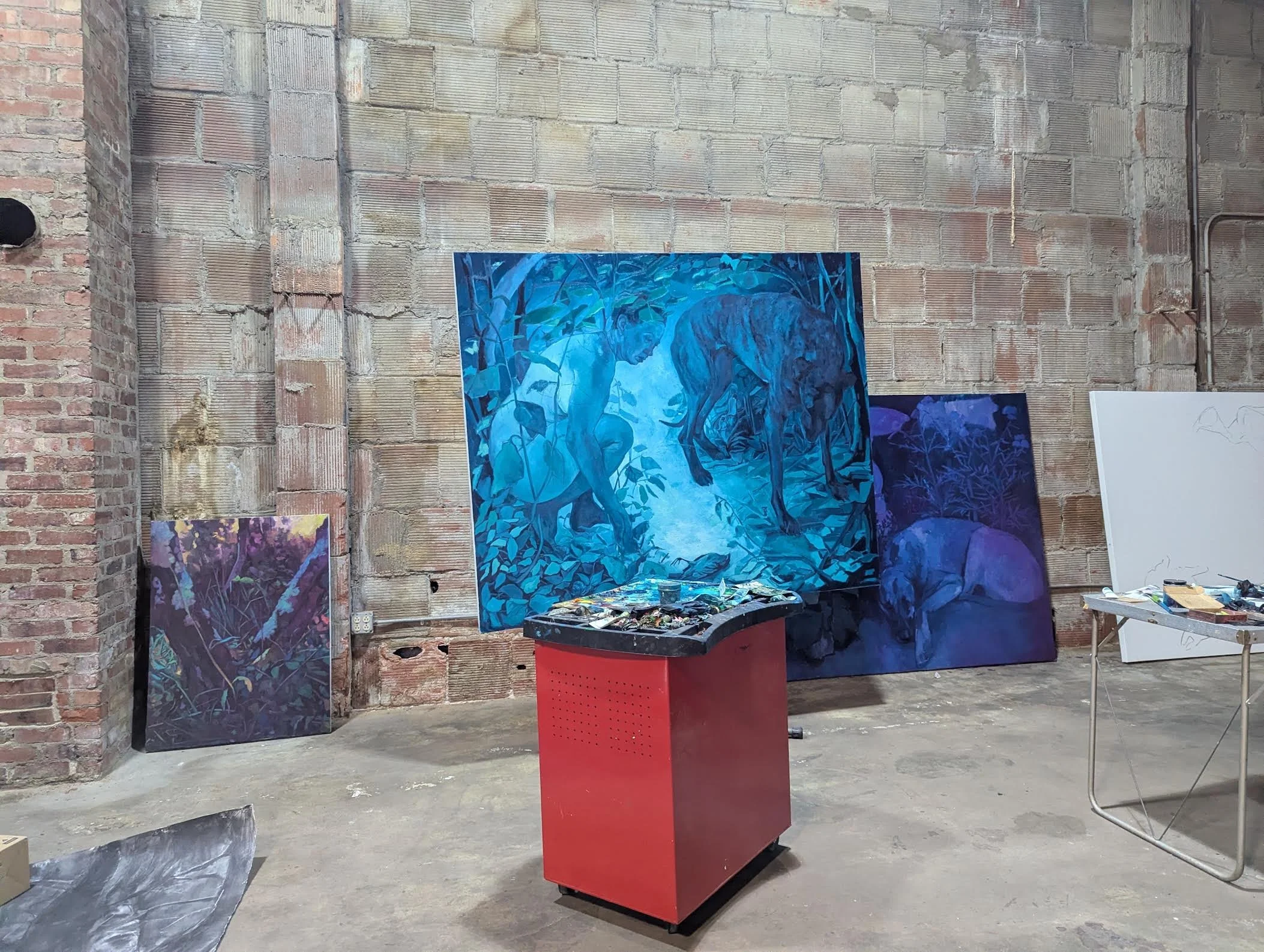
Q: I’m curious what drew you to the color blue in your recent paintings?
A: I’m trying to translate the drawings, and that’s something I've been thinking about for a while: how or if the drawings can become paintings, and I think scale is part of that, but limiting the palette is the other part, and so extremely limiting the palette is letting me jump back in from a drawing brain to a painting brain. And then I've been thinking more about these temperature relationships and this idea of a diorama or something artificial but close to something more naturalistic. I spent a long time thinking about museum dioramas and how we’re supposed to suspend disbelief when we're looking at them. I recently went to Disney World with my son, and he's kind of fascinated with the artifice of everything, so looking at it through that lens, all of Disney World is this immersive experience and a lot of these environments are created through layering different colored lights and textures. It's really fascinating that there are these warms and cools strategically layered to create this sense of light that is really similar to how I think when I’m making drawings, even when I’m monochromatically making drawings; there's a kind of light I’m thinking about that isn't necessarily achromatic. So with these glazes working on top of each other, eventually I'm going to pull warms out of that to see if I can get those temperature relationships to create this glowing light.
Q: Is it difficult for you to move back and forth between charcoal and painting?
A: My background is in painting, so in some ways I’ve been working on charcoal drawings for a long time, and they started as studies for paintings and took on a life of their own. Then I think a lot of it has been time constraints, so I’ve always had a painting practice alongside the drawings, but the drawings have taken priority, and I think conceptually there are some material considerations with the drawings that work better with the subject matter. I’ve stepped back from admin in July, so I've been sort of in the back of my head prepping and thinking, “Oh, I get to paint again”. I think painting does require more time; I can leave and come back to a drawing fairly easily, whereas if I have a painting open, I want to be able to spend 4 or 6 or 8 hours or come back the next day on it. I've been thinking strategically and getting surfaces prepared for painting, and going back and forth on the drawings and thinking about the time I have here and also my academic schedule.
Q: How do you find the mediums influence each other?
A: I think it's one of those things that when I'm working on the large-scale drawings I don’t think of them as drawings necessarily; I'm always thinking in paint in a way and like the way the mark moves, the way the light moves, or the references I’m drawing from; it's a painterly process. There's a facility that happens with drawing that I can have a faster hand that comes over to the paintings, and especially as I'm working on a large scale, I'm thinking in
You can learn more about Melanie here.